
It’s almost like trying to explain a faded dream that you had the night before because it’s dismissed in a way to nothing, isn’t it?
by the Editorial Team
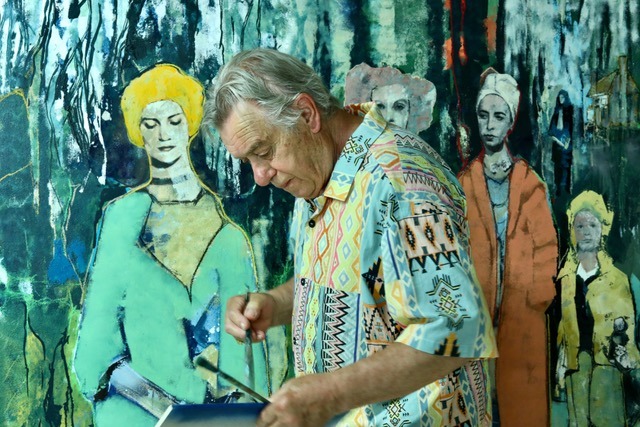
Artist Jack Watto is preparing for a forthcoming solo exhibition at Lumina Gallery. Known for emotionally charged paintings that sit between abstraction and figuration, Jack describes his practice less in terms of fixed “isms” and more as a direct response to lived experience, memory, and moral unease.
A tightly curated exhibition space
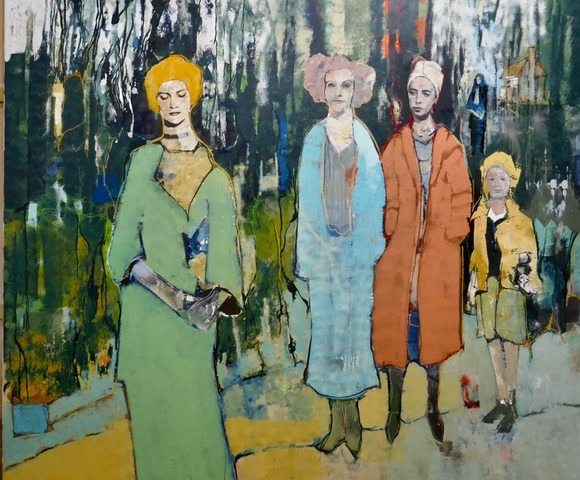
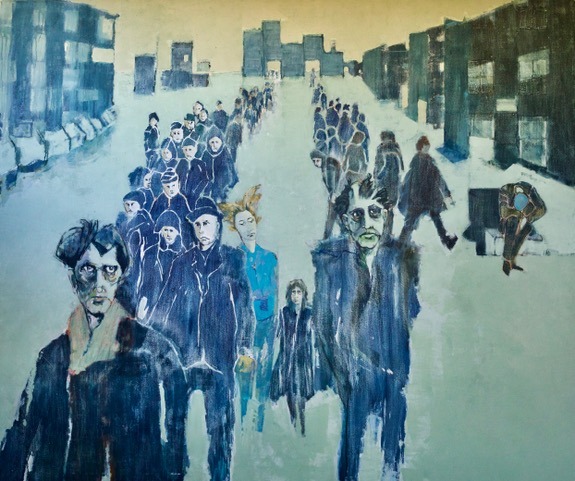
The exhibition, titled, ‘The Brush Leads the Way,‘ will be installed in Lumina’s small downstairs gallery space, formerly a jungle plant shop. It will feature three large works (around 2m x just under 2m, two medium works and approximately six smaller pieces.
A practice driven by narrative and emotion
Jack resists rigid labels such as “abstract expressionism or “post-figurative” terminology, which he feels obscure rather than clarify artistic intent. Instead, he emphasises that his work is fundamentally about expression through figures, marks, and instinctive composition—what he calls “creating an expression of meaning through figures.”
His process begins not with a fixed plan, but with an emotional or ethical trigger. Events involving human suffering, conflict, or injustice often become the starting point for a painting. One key example he references is the historical Magdalene Laundries in Ireland, which he intends to explore in a new major work. The subject matter reflects his broader interest in institutional harm and suppressed histories.
Painting as evolving discovery
Working from his studio in Kettering, Jack works through an intuitive, evolving process, rather than constructing images in advance.
Paint is applied, shifted, removed, and reworked until forms begin to emerge. Figures often appear gradually within the composition—sometimes a nun, a distressed young woman, or symbolic architectural elements like industrial boilers or washing structures.
He describes the experience as similar to interpreting a “faded dream,” where meaning becomes visible only through sustained engagement with the canvas.
“It’s quite difficult to put into words what’s in your imagination really, isn’t it?
In my imagination I can see on the canvas as I’m making these marks and pushing this paint around where the structure or the format of the painting is going to be.
In other words, I’ll move the brush around and all of a sudden a nun will appear.”
It’s almost like trying to explain a faded dream that you had the night before or something because it’s dismissed in a way to nothing, isn’t it?
Works may remain in progress for months or even years, continuously revised until a moment of resolution arrives—though even then, he acknowledges that paintings are never truly finished, only released.
Themes: conflict, humanity, and environmental unease
Across his body of work, several recurring themes emerge:
- Human suffering and institutional abuse
- Religious and moral contradiction (without religious belief)
- War, migration, and displacement
- Environmental destruction and ocean pollution
- Broader reflections on the “human condition”
“It’s nothing about religion,” Jack is quick to point out, but exploring the human condition through art.”
One large-scale piece in the exhibition is structured almost like a visual narrative, reading from left to right like a sequence of scenes: women representing trauma and resilience, figures symbolising famine and war, and younger characters witnessing unfolding catastrophe. Rather than a single image, it functions as a layered storyboard of global crisis.
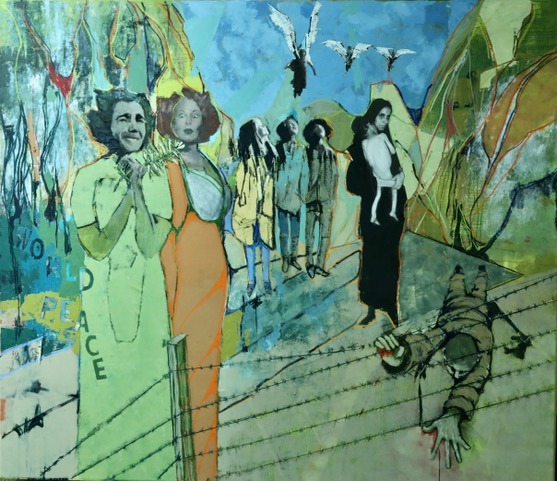
Another major work references the Passion of the Christ (Mel Gibson’s film), not as religious commentary, but as an exploration of suffering, sacrifice, and human conviction.
Materials and technique
Jack works primarily in oils but frequently shifts technique depending on the emotional direction of the piece. His methods include brushwork and traditional oil layering, spray application, dripping and gestural mark-making, dilution and thick impasto effects and mixing with wax to build texture.
The choice of technique is not predetermined but arises from the subject matter itself—each work dictating its own material language.
Influence and artistic position
While he acknowledges admiration for contemporary figures such as anonymous street artist, Banksy and Christian Hook, Watto is clear that his core influence comes from his early tutors, particularly Keith Vaughan and Frank Auerbach, whose approaches to figurative painting and expressive distortion left a lasting imprint.
Despite this lineage, he positions his work as internally driven rather than stylistically derivative. The paintings, he suggests, are not designed to illustrate ideas but to contain struggle—both personal and collective.
What viewers will encounter
Ultimately, Watto’s exhibition at Lumina Gallery is designed to do more than present finished artworks. It asks viewers to slow down, read images as layered narratives, and engage with unresolved emotional and ethical tensions.
He is explicit about this intention: the work is not decorative, but communicative. It asks the viewer to “stop, think, and try to understand,” offering access not just to visual imagery, but to the psychological space in which the paintings were formed.
As the exhibition comes together, its success will likely depend not only on individual works, but on how the tightly packed space amplifies their intensity—transforming a small gallery into a dense, immersive encounter with Watto’s evolving visual language.
“The Brush Leads the Way” Solo Exhibition will take place at Lumina Gallery, 9 George Row, Northampton NN1 1DF from 6th to 13th June 2026. For further details visit: https://northantsmag.co.uk/event/solo-exhibition-by-artist-jack-watto